
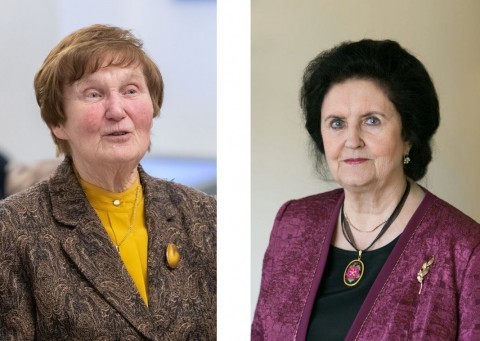
The Estonian government approved the recipients of this year’s Lifetime Achievement Award for Science. The award for long-term research and development work, amounting to €40,000, goes to Ingrid Rüütel and Ene-Margit Tiit.
Minister of Education and Research Liina Kersna congratulated all award recipients and thanked them for their contribution to Estonian science. “I am impressed and inspired by the way the recipients have dedicated themselves to science and have passed on their knowledge to the next generations for 50 years,” Kersna says.
Ingrid Rüütel is one of the founders of Estonian ethnomusicology and an active researcher of folk music. She is also a long-term influential leader and advocate for folklore research. In her research papers, Rüütel has brought attention to the melody of Estonian runo songs and the peculiarities of Finno-Ugric folk music in general. She created the typology and a database for Estonian and Votic runo songs and identified the unique layers of the Estonian folk song as well as the role of ethnic relationships in its development. Rüütel has also studied folk culture and the expressions of ethnic identity. As an active researcher, she has collected thousands of folk songs and participated in the production of many scientific films over several decades.
Ene-Margit Tiit is the founder of the Estonian mathematical statistics field and the school of the respective field. She is known for supervising and educating generations of statisticians, developing scientific language and advocating statistic literacy in the society. The main aim of her research is to analyse pressing issues among society (such as divorce, poverty and the COVID-19 pandemic) and find possible solutions. Her most significant achievement is contributing to social and political sciences by creating a statistical base for family and demographic research in Estonia in addition to developing methodology for the cross-use of registers for census surveys. As Tiit is sensitive to social issues, she often takes part in public debates.
Awards for best research papers
Research papers that have been written and published in the last four years are awarded with annual awards, the amount of which is €20,000.
This year, the annual awards will be presented to:
- Ivo Heinmaa and Raivo Stern for the research series in exact sciences “Kord ja korratus frustreeritud magneetikutes: tuumamagnet-resonantsuuringud”.
- Priit Väljamäe for the research series in chemistry and molecular biology “Enzymatic degradation of recalcitrant polysaccharides”
- Ants Kallaste (the head of the collective), Toomas Vaimann, Anton Rassõlkin and Hans Tiismus for the research series in engineering “Kihtlisandustehnoloogial põhinevad elektrimasinad”
- Pärt Peterson and Kai Kisand for the research series in medicine “Immuunsüsteemi vananemise ja Covid-19 haiguse uuringud”
- Siim Veski and Anneli Poska for the research series in geo- and biosciences “Mineviku õppetunnid: jääajajärgne keskkond muutuva kliima ja kasvava inimmõju tingimustes”
- Ebe Merilo and Hannes Kollist for the research series in agricultural sciences “Taimede kohanemine muutuvas kliimas”
- Veronika Kalmus (head of the collective), Marju Lauristin, Anu Masso, Signe Opermann, Peeter Vihalemm and Triin Vihalemm for the research series in social sciences “Eesti ühiskonna transformatsioon: analüüs ja mõtestamine”
- Karsten Brüggemann for the research series in the humanities that analyses how the Russian Empire (and USSR) cope with ethnic and cultural diversity as well as the history of the Baltic states.
