
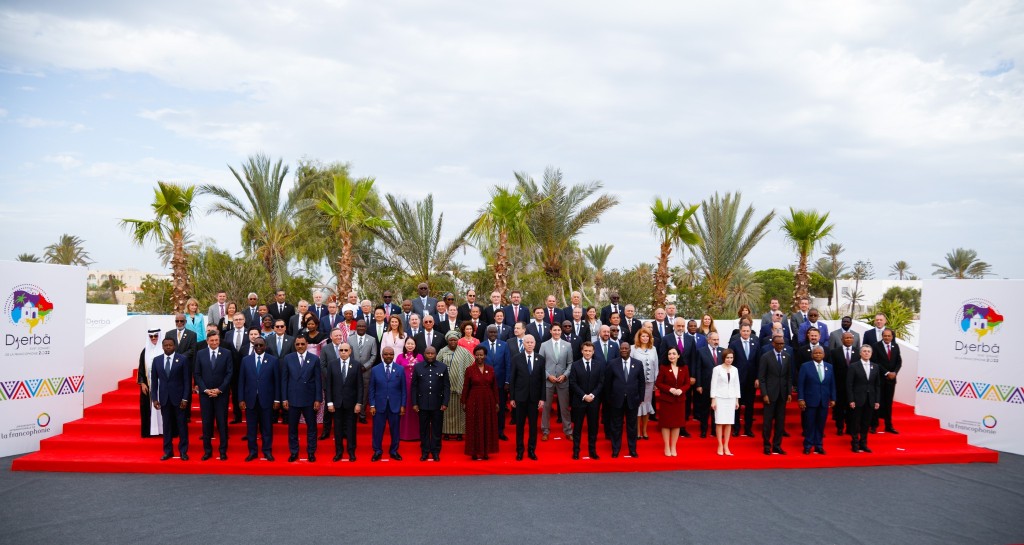
On Friday, Minister Tõnis Lukas took part in the annual ministerial meeting where the progress was discussed in the programs adopted at the previous summits, including the Digital Francophonie Strategy adopted last December. "Estonia can contribute to the implementation of the digital strategy by sharing good e-governance practices as well as creative digital solutions, including the use of artificial intelligence and machine learning, especially in the field of language technology," Lukas pointed out in his speech. "Connectivity - physical and shared infrastructure is the backbone of our connections, our security and the global economy," added Lukas.
Topics prepared for the summit were also discussed at the ministerial meeting: consolidation of crises and peace, the role of the French language, OIF's strategic framework 2023-2030, and the rules for the conditions for joining and changing membership status in OIF. A significant part of the debate was devoted to Russia's continued aggression in Ukraine and its global implications. The OIF has unequivocally condemned the initiation of this war.
On Saturday and Sunday, Lukas participated as a representative of Estonia at the summit chaired by the President of Tunisia, Kais Saied.
During his visit, Lukas met with the Tunisian Minister of Education and Science, Fethi Sellaouti, and discussed cooperation opportunities in the digital and educational fields, especially considering the planned Tunisian education reform, which also includes the development of curricula and updating of pedagogical methods. Sellaouti was primarily interested in educational equality, engineering education and the autonomy of schools in Estonia. The ministers agreed to work towards stronger bilateral cooperation.
Bilateral meetings were also held with the Minister of Foreign Affairs of Niger, Hassoumi Massaoudou, the Minister of Foreign Affairs of Rwanda, Dr. Vincent Biruta, and the Minister of State of Cote d'Ivoire, Kandia Camara. At the meetings, Lukas drew attention to Russia's continued aggression in Ukraine and its global implications. "We must continue supporting Ukraine, using all available means of influence, also on the international scene, including in the United Nations," said Lukas.
Lukas said during the OIF visit that increasing the role of the French language in Estonia is important. According to Lukas, it is important to increase young people's options for learning foreign languages, for example French and German, and to reduce the share of Russian in curricula, as well as the dominance of English. "The future of our children and the scope of culture and the opportunities for further studying would be more diverse if more people knew other European languages as well."
The Estonian delegation also included Estonian Ambassador to France Lembit Uibo and Estonian Honorary Consul in Tunisia Abdeljelil Bouraoui.
The primary goal of OIF is the promotion of the French language and linguistic and cultural diversity, but it is equally important to support member states in protecting peace, democracy, and human rights, supporting education, higher education, and science, and promoting cooperation on sustainable development. The organization has a total of 88 members and observers. Estonia has been an observer member of OIF since 2010.

