
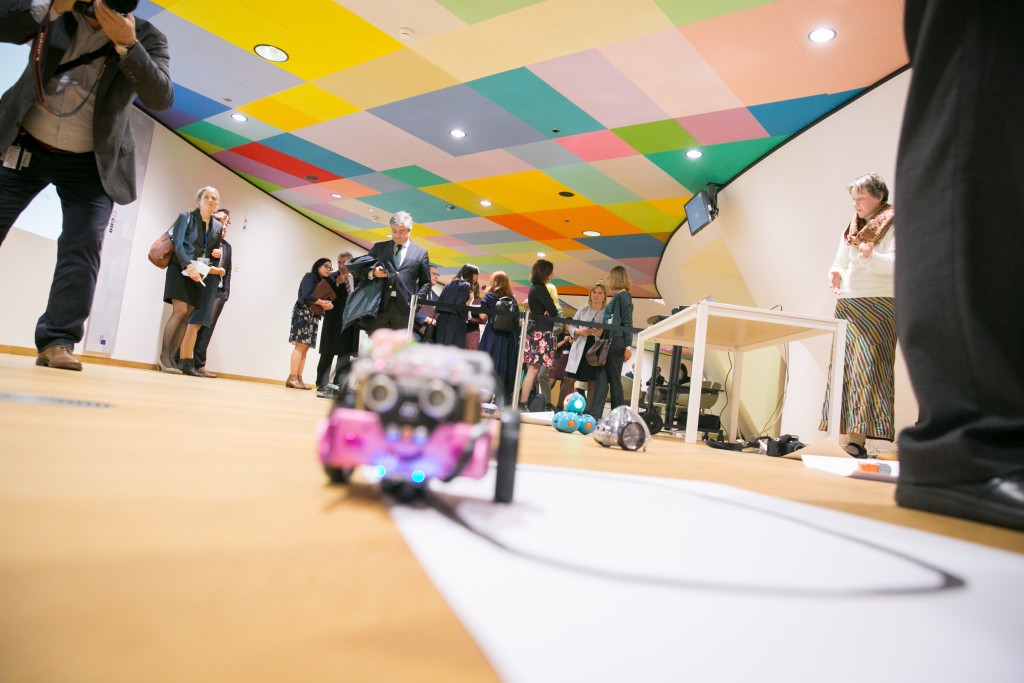
At their meeting in Brussels yesterday, 20 November, the education ministers of the European Union made several important decisions regarding graduate tracking, modernising general education and higher education, and cooperation in the future. The pupils of the Rakke Secondary School demonstrated their robotics skills to the ministers, showing how new technologies are used in Estonian schools.
"The education issues that have been addressed in the course of the Estonian Presidency form a perfect whole and will inform cooperation in all areas of education. I am glad that we understand each other very well and are passionate about developments in education. As a result of this meeting, we have a strong mandate and clear guidelines for developments in strategic EU cooperation and programmes," said the Estonian Minister for Education and Research Mailis Reps, commenting on the work in the Education, Youth, Culture and Sports Council.
The meeting of ministers began with discussions on efficient learning environments and extracurricular activities that support the development of children, framed by a robotics workshop. A representative of Robotex as well as a teacher and students from the Rakke School demonstrated how robots are used to acquire traditional knowledge, such as mathematics. Robotics improves how the young attain new knowledge by connecting what they learn to real life.
The discussion on vocational education was introduced by Risto Mäeots, Estonian Entrepreneur of the Year of 2017, who shared his experiences in organising apprenticeships in the aircraft maintenance company Magnetic MRO. In the subsequent discussion, the ministers noted that the borders between different sectors of education are becoming obscured; general education and higher education are incorporating elements of vocational education and the proportion of generic skills in vocational education is increasing. Another trend is a more individual approach to composing education and training supply. Teachers and trainers continue to have the crucial role in ensuring quality in education, and new teaching methods should be promoted.
At the meeting, ministers adopted the Council recommendation that draws attention to the importance of collecting data and to studies on tracking graduates of vocational and higher education institutions. The ministers also reached an agreement on calling on member states to contribute to developing the talents and potential of all students.
